
Musician’s names
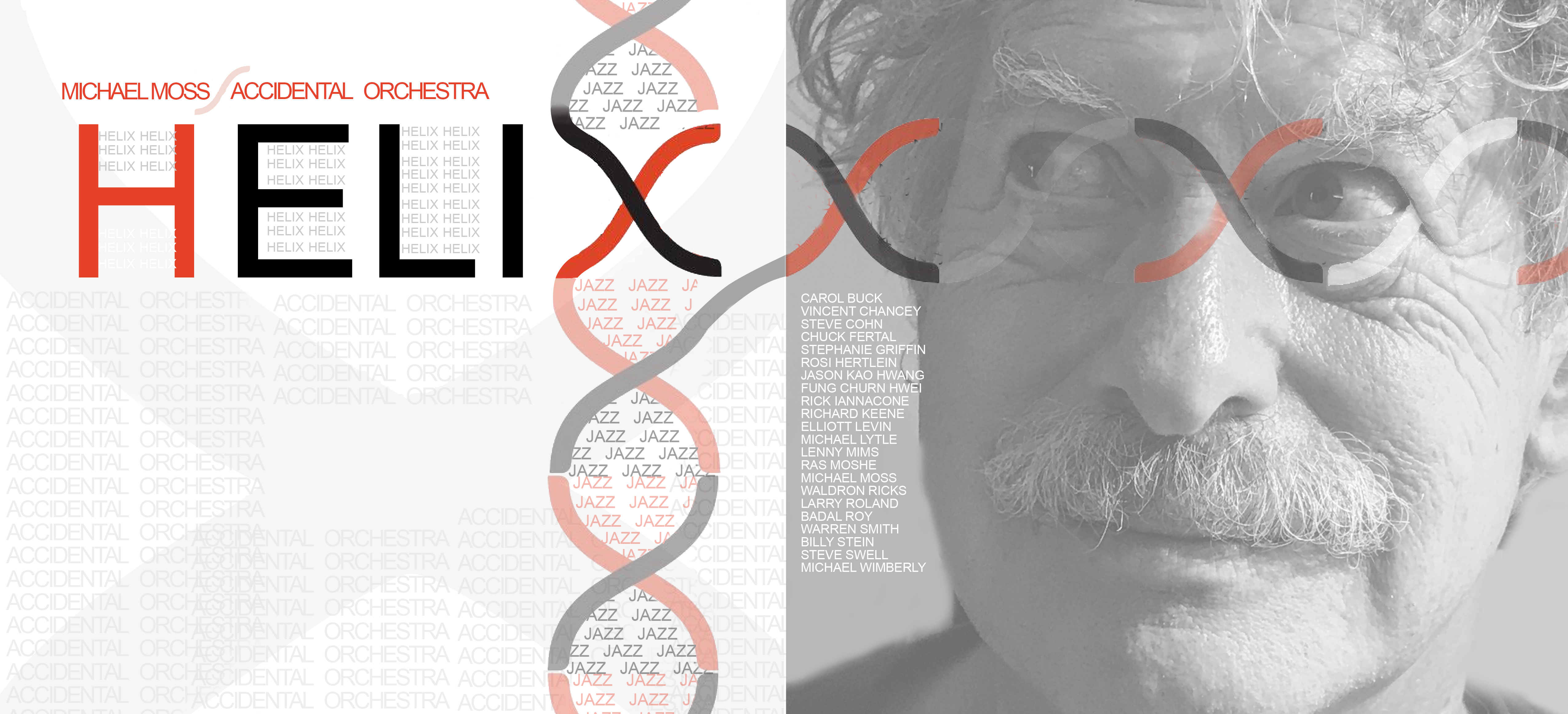
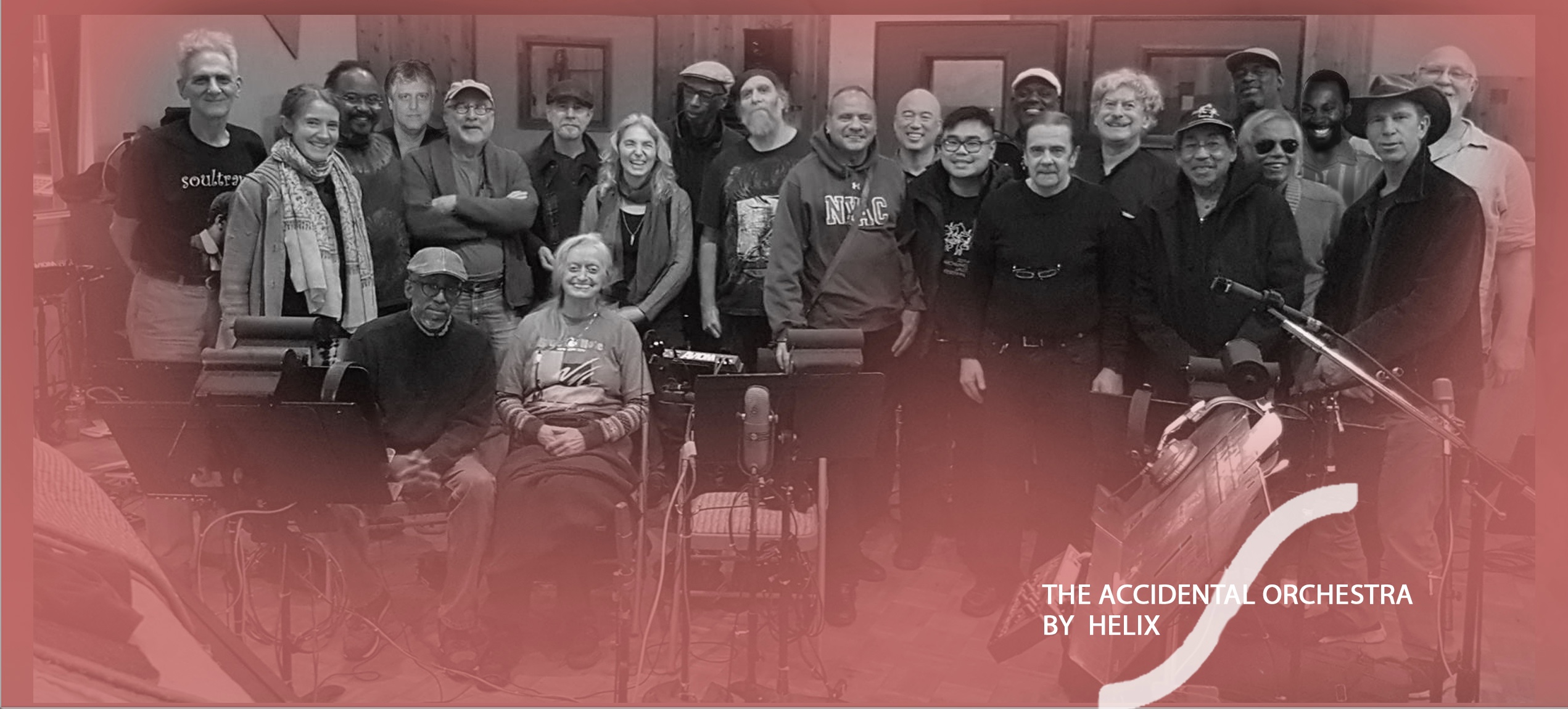
Jason Kao Hwang, Rosi Hertlein, Fung Churn Hwei (violins), Stephanie Griffin (viola), Lenny Mims and Carol Buck (cellos), Steve Swell (trombone), Vincent Chancey (French horn), and Waldron Mahdi Ricks (trumpet), Richard Keene (oboe), Elliott Levin (flute, tenor saxophone), Ras Moshe Burnett (soprano and tenor saxophones), Michael Lytle (bass clarinet), Michael Moss (Bb clarinet), Steve Cohn (piano), Billy Stein (guitar), Rick Iannacone (ambient guitar), Larry Roland (string bass), Warren Smith (percussion, vibraphones), Badal Roy (tabla), Chuck Fertal (drums), and Michael Wimberly (djembe, African bells and percussion).
“I cannot do more than hint at what intuition and creativity are, even though I wrote my doctoral dissertation on it. The music took me over. I would awaken with new musical ideas emerging from my unconscious, opening a portal so more musical ideas came streaming in. I wanted every musician to solo—accompanied by fluctuating combinations of orchestral elements with varying colors, shades, and textures. C# or Bb, See Sharp or Be Flat memorializes an accident: I tripped over a curb, breaking my leg. It grew from a 32 bar phrase into a contrapuntal theme and variations for 22 musicians. The Old One, named after Einstein’s penchant for referring to God as the Old One, follows a musical transmigration of souls transitioning from death to rebirth as the soul progresses from one state to another on the way to reincarnation or attainment of its Buddha nature as described in The Tibetan Book of the Dead, and alternatively describing the passage of the soul from the death of the body to sitting at the feet of God as described in the Qabbala.
HELIX and THE THEORY OF EVERYTHING
WAVE/PARTICLE :: UNCERTAINTY=POSITION/MOMENTUM
In Einstein’s 1917 paper The Quantum Theory of Radiation, photons stimulate the emission of photons by striking and being absorbed by molecules and by raising energy to the point at which new photons are emitted, thus lowering the energy (coincidentally, the theory behind the MASER, LASER, and quantum entanglement) by utilizing the equivalence of mass and energy (e=mc2). This posits the existence of the light quantum, radical since photons were not recognized as yet by the physics community, hence the title. Einstein felt his theory had a weakness—he really wanted there to be a “union with wave theory” and found this to be the greatest weakness of the quantum theory of radiation. He is searching for something but cannot reach it. He knows there must be something about this that explains particle-wave duality but cannot come up with it utilizing the level of experimental knowledge of the time, and cannot therefore arrive at ways to experimentally verify what he intuitively “knows” is true.
Now (2018), a hundred years later, the gap is closed. New work (http://www.huffingtonpost.com/2014/12/24/quantum-physics-easier-to-understand_n_6370570.html) suggests wave and particle duality are the equivalent of Heisenberg’s uncertainty principle in which there is a relative duality between position and momentum. That is, like particles vs. waves, position and momentum can only be measured separately—if one measures a particle’s position one can no longer measure its momentum, and vice versa, if one measures its position and knows where it is, how fast it is going can no longer be measured. This article states that they are relative—two sides of the same coin; waves and particles are really identical. To put it bluntly, momentum and position are relative, just as space and time are relative and particle and wave are relative.
The equivalence principle founds much of Einstein’s later work and led to the generalization of the Special Theory of Relativity. It took from 1905 until 1915 to attain this goal in the Theory of General Relativity, which forced physics to relativize space and time. Now the principle of equivalence leads to a further relativisation—particle and wave are now relative not only to each other but to position and momentum. It took a century but Einstein was proven right again. What interests me is the implication that there might be a bridge here between quantum theory and relativity theory.
The implications of equivalence can immediately be applied to cryptology. What simple mathematical formula describes this four-part harmony between matter, energy, where that matter is, and how fast it is moving? With so many variables, we should be able to avoid anyone hacking into and stealing records of our credit cards because they are encrypted on so many levels. For me—leaving cryptologists to the Turing test—I ask the question: what simple mathematical formula describes this four-part harmony?
I sense we are approaching unity—the nexus of Einstein’s model of a macro universe and the Copenhagen School quantum theory of Bohr, Heisenberg, Pauli, and Schrödinger. This nexus fascinates me because I do not believe Einstein would have predicted it and neither would Heisenberg. This may throw light on whether or not Schrödinger’s cat is alive or dead.
Einstein’s quest for a unified theory extends: Kaluza-Klein theory adds a 5th dimension, string theory adds six more to that, and still there is no experimental proof that there is a 5th or an 11th dimension. The first—Kaluza-Klein— disappointed Einstein secondary to lack of data, and the second—string theory/M theory—disappoints a couple of generations of string theorists. What if the results of the classical double-slit experiment—the essential paradigm of particle-wave interaction—represent Einstein’s idea that both wave-particle and uncertainty theory are relative to one another? Well, they are, but only if measuring momentum or position are flip sides of the coin of the principle of uncertainty and there is an equivalence between this and wave-particle theory. I visualize a multidimensional propagating wave whose particle manifestation can be measured either as velocity or position, also known as the Schrödinger wave.
It’s as if one of the Star Trek movies came to life and you can beam up Captain Kirk. Add to this the relativity of space and time and I see the Tardis ripping through the fabric of the elegant universe.
Too bad the article I read skims the finding because, even though I AM NO MATHEMATICIAN, I’D LIKE TO SEE SOME FORMULAE. THE NEXT STEP IS THE FORMALIZATION OF THESE EQUIVALENCIES SO AS TO MAKE PREDICTIONS. THAT’S when the pedal hits the metal!
Let’s take this one step farther and include non-western ideas expressed in the religions of Buddhism and Hinduism in which space-time relates to tao. You might want to check out The Dancing Wu Li Masters by Gary Zukav at this point. I have noticed a confluence as far back as the 1960s when I was first experimenting with the I Ching and reading into the kabbalah, The Tibetan Book of the Dead and The Egyptian Book of the Dead, and later my exploration into the Torah to find musical connections between physics and mathematics, spirit, and music.
HELIX
After some time my compositional skills have been developed to the point that I compose music for a small jazz renaissance orchestra I have named The Accidental Orchestra. A renaissance orchestra is the original orchestra with sections composed of brass, strings, and reeds. I took the concept in the 1970s and added to it a rhythm section, then composed music for these artists to improvise from. The original renaissance orchestra I brought together I called Free Energy. After 40 years I am returning to the form on steroids.
My first cd featuring The Accidental Orchestra is entitled HELIX (4th Stream Records, available on http://www.michaelmoss.bandcamp.com, https://michaelmoss.hearnow.com/helix, AND https://store.cdbaby.com/cd/michaelmoss). On HELIX I present two compositions. C# or Bb/See Sharp or Be Flat tries to bring together pop music, soul music, gospel music, jazz of the 1930s and ’40s, alloyed with 21st century instruments and harmonic evolution. Using 4/4 time adds to the feeling of familiarity and muscles the musicians into older forms of expression as well as encourages the expression of abstract musical ideas–ideas born out of the history of jazz within a structure familiar to us all, while at the same time giving them new relativity in the web of spacetime. The Old One, a suite in five movements, is my homage to Beethoven, Bartok, Stravinsky, Carter and the symphonic form. I have added a 5th movement to the customary four because the music demands it. It is hard to say if I succeeded musically but I have found by listening to it over the past year a few times that it becomes easier to comprehend because the form and structure are less daunting and familiarity with the different movements makes it easier to concentrate on the music and to associate my admittedly mythical ideas having to do with the soul and the transcendence of the spirit with a musical expression. I’ve been looking at the score again and that is helping me understand solo order. Which makes the point I have been leading up to more salient.
Nowhere in any review do writers refer to the religious ideas specifically enough to follow what my musical intent has been. Therefore I have taken it upon myself to elucidate what are for me the founding principles of The Old One which follows the passage of the soul from life to rebirth in the Godhead, what I call the Throne of Gold. This form of transfiguration referred to as the transmigration of souls in Kabbalah is obvious if you have been inducted into spiritual disciplines but I am trying to make the obvious musical, if that makes any sense. Sense is the sound of individual and group string players, reed players, percussion, keyboard and guitar and bass players, in other words, the sounds of the instruments of the musicians of the renaissance jazz orchestra–The Accidental Orchestra.
Each movement of The Old One takes the soul through some sort of archetypal experience on the way to rebirth. This is where I feel transcendence, reincarnation, life after death, heaven and hell, devas and dashikis, relativity theory and quantum physics come together. There are Native American connotations if you listen carefully. I try to allow the primitive as well as the abstract room to breathe because they are relative to each other and to the spirit. So, for example, what we play in the very beginning, the first movement entitled Inception musically represents the moment of death and the soul’s experience of death as the way is revealed. I am not making a statement that there is life after death–I am only imagining that if there is such a thing this is how I would hear it. Translating how I would hear death and transfiguration was my mission so I compositionally pair musicians together depending on my experience of them in the past, predicting what they can do in the future. Boy was I surprised! There are levels implied by the first movement, Inception, just like the multi-verse some physicists speculate is a natural consequence of quantum splitting at each quantum measurement in which the wave collapses.
Like the movie Inception this is a movie score of the unconscious and, if you put yourself in the right mood, could help you enter your own unconscious in a form of trance-induction. We all have intuition and it is one of my theses that through intuition we feel the entirety of existence in music. In poetry, visual and performance art, bodies dancing through spacetime, let us see and feel the wave that carries us all forward, just as Schrödinger and his wave-form equation describes as wave-particles (let’s call them wavicles) on the level of quantum mechanics.
Qabbala::Entanglement, a piece I originally wrote in 2009 for small group but which I have just adapted for the AO, makes this same statement in the explicit form of the Tree of Life in the kabbalah. Each of the ten stages of the tree of life is called a sephira in Hebrew; sephirot have been studied for around a thousand years at this point by different mystics, from various religions, and more recently by Jungian psychologists of which I count myself a lay member having read just about everything Jung wrote. Jung serves as a springboard, a portal through which ideas flow. In graduate school my doctoral dissertation (The Meaning And Measurement Of Jung’s Construct Of Intuition: Intuition And Creativity) made hypotheses about the nature of intuition, creativity and Jung’s psychological types. My research found that there is little daylight between the psychological type of intuition and creativity as measured by three tests and analyzed by a senior statistician.
Now that I know Jung has some traction in the real world I believe I can follow him into the world of the collective unconscious as I hear it and play it. Actually, thinking mythologically provides guideposts along the way of collective improvisation. During some pieces the sounds produced by simultaneously improvising musicians become so dense that I want to write them out to recreate them whenever I want. I can’t really write out what they are doing so I make room for them to do it themselves by imagining musical white space within which they can do their thing.
I really can’t wait to hear the AO perform C# or Bb/See Sharp or Be Flat, and The Old One again because the structure will remain the same but the quantum leap of understanding I have made may match that evolved musical understanding of the adventure my musical friends take each time they play. This applies as well to new pieces I have adapted to the AO format such as Forget Remembering Being Born based on the third book of Moses in the Torah and Qabbala::Entanglement.
If you think listening to a piece at different times is different each time, try starting out with implied structure, pure and simple openness to what is going on around you, with notes, intervals, textures, and Schrödinger waves abuilding so that we surf the big kahuna. That’s when it’s really happening. That is the experience to shoot for when finding the arc of the compositions we study, compose, and listen to. This wave characterizes music in a way I first noticed listening to Beethoven. I have been following it, surfing it, playing with it for a long time now and, being eternal, it never gets old.
The helix: a recurrent spiral that returns to the place of origin but never repeats itself; a spiral of creativity. The helix is a metaphor for revisiting and developing past musical ideas, inventions and pieces I want to expand (or contract) so I can grow as a musician, a composer and a performer. Helical structures include ribonucleic acid, deoxyribonucleic acid, the two fundamental organic molecular protein-like folded life-giving nucleotides–RNA and DNA. A helix, in this case HELIX, gives life to beautiful music from a distant future and a primitive past all in the moment, all in the now. The Accidental Orchestra brings new life to the old metaphorical truths of justice and injustice where justice is the note-choice and injustice the same note-choice heading from the future into the past just as particles and anti-particles interact–the particle is going into the future and the anti-particle is heading in the opposite temporal direction, all on the quantum time level. That’s how fast the music is and how fast our quantum brains are operating to play this music, and how quickly your quantum brains instantly understand the music even if it’s unfamiliar to you. It is like a circle where there is no end but you eternally return to the same place but in a different temporal dimension.

